 The 15th Court of Appeals has granted a petition for writ of mandamus in a case in which an out-of-state environmental advocacy organization intervened in a state enforcement action against chemical manufacturers permitted by the TCEQ. TCJL filed an amicus brief in support of Relators.
In re Dow Hydrocarbons and Resources, LLC and Union Carbide Corporation (No. 15-26-00119-CV; October 22, 2026) arose from a dispute over compliance with Relators’ water permits. The state initiated an enforcement action while the parties worked to resolve the issues. In the meantime, a New York entity, Waterkeeper Alliance, sought to intervene in Travis County district court, asserting the same claims as the state in a “me-too” action. Both Relators (by way of a Rule 91a motion) and the state moved to dismiss Waterkeeper from the case, but the trial court denied their motions. Relators sought mandamus relief from the 15th Court of Appeals.
In an opinion by Chief Justice Brister, the court granted mandamus relief. The only order before the court was the trial court’s denial of Relators’ Rule 91a motion. Waterkeeper argued that an intervention can only be challenged by a TRCP 60 motion to strike. The court disagreed, observing that when Rule 91a was adopted in 2013, it explicitly provided that the rule was “in addition to, and does not supersede or affect, other procedures that authorize dismissal.” Turning to that issue, the court noted that “[i]f a private party files a statutory claim in the absence of any private cause of action, then by definition that claim has no basis in law.” Rule 91a was thus a proper vehicle for challenging Waterkeeper’s intervention.
The court next addressed whether the Water Code authorizes a private cause of action. The answer was no. Courts can’t imply a statutory private cause of action in the absence of clear statutory authority. In the context of this case, the only case in which a private individual could bring a claim involves releases of radioactive material, which applies to persons affected by the release. Clearly, if the Legislature expressly granted this authority in one instance, it could have done the same for other environmental violations. Additionally, Waterkeeper failed to show that it had a justiciable interest in the litigation. “Intervention specifically requires a showing,” the court observed, “that the intervenor ‘could have brought the pending action, or any part thereof, in his own name.’” And while the Water Code (§ 7.110) provides that the attorney general may not oppose intervention by a person with standing, the statute limits that authority to an objection to a settlement between TCEQ and an alleged violator. This type of intervention is a very different thing, the court stated, than “intervention to file charges, prosecute, seek discovery, and conduct a trial of such actions.” The court held that Waterkeeper had no statutory cause of action.
The court further held that Relators had no adequate remedy at law. “The [Texas Supreme] Court several times recently has held that mandamus ‘is available to end a lawsuit when Congress has determined that no such suit may be brought,’” the court concluded. “Texas laws restricting private claims are entitled to the same respect as those adopted by Congress. In matters like this, we ‘must be careful to stay in our lane’; allowing private activists on either side of environmental issues to intervene as parties would not do so.” The court conditionally granted the writ.
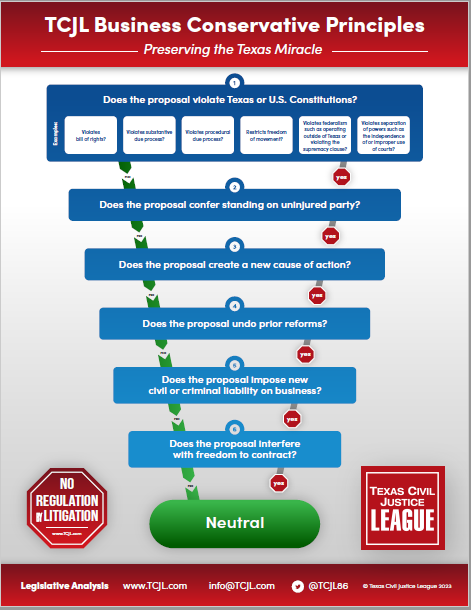
We applaud the court’s decision. TCJL’s brief attacked Waterkeeper’s standing to intervene and focused on the organization’s stated purpose to pursue litigation to enforce federal and state clean water laws. Waterkeeper coordinates state actions from its headquarters in New York at the direction of its general counsel, a former litigator for a “public interest “ law firm dedicated to suing American manufacturers for alleged environmental violations. Our brief fully exposed the identity of the organization and called out the blatant lawfare that is becoming characteristic of the “injury in law” trend in both the legislature and the courts.