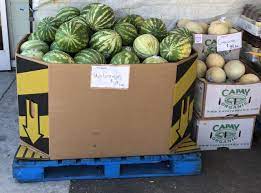
 Plaintiff went into a grocery store in south Texas to buy a watermelon. The watermelons were displayed in large cardboard boxes sitting on pallets. The pallets had open sides. The corners of the boxes had large red arrows printed on them warning people not to trip over the exposed corners of the pallets. Plaintiff went to a bin to pick out a watermelon. As he looked them over, the steel toe of his boot entered one of the open sides of the pallet. When he picked a watermelon and turned to leave, the toe of the boot got caught in the pallet and plaintiff fell, injuring his elbow. He sued the grocery store on premises liability, negligence, and gross negligence theories. The jury found the grocery store grossly negligent and rendered a multi-million verdict. The trial court entered judgment on the verdict and denied the grocery store’s JNOV and new trial motions. The grocery store appealed.
These are the facts of Pay and Save, Inc. v. Canales (No. 04-20-00125-CV). In an opinion by Justice Alvarez, the court of appeals determined that the jury’s finding of gross negligence was based on factually and legally insufficient evidence. In a premises liability case, a plaintiff invitee must provide that “the premises owner knew or should have known of a dangerous condition on the premises that presented an unreasonable risk of harm and that the condition proximately caused the plaintiff’s injuries” (citations omitted). Proof of either actual or constructive knowledge of the dangerous condition may be sufficient, and whether an unreasonable risk of harm exists requires proof of “a sufficient probability of a harmful event occurring that a reasonably prudent person would have foreseen it or some similar event as likely to happen” (citations omitted). Mere evidence that the premises owner knew of a safer, feasible alternative design is not in itself sufficient to show that the owner knew or should have known that condition of the premises created an unreasonable risk of harm” (citations omitted). In the absence of evidence of the owner’s actual knowledge of such a condition, the owner’s constructive knowledge may be established under the “time-notice rule,” under which a “condition exists long enough to given an owner a reasonable opportunity to discover a temporary or changed condition such as ‘a piece of partially melted ice on a tile floor’” (citations omitted).
Moving on the sufficiency review, the court determined that plaintiff’s burden in the case “was to prove that the pallet’s side openings presented a sufficient probability of an injury occurring that Pay and Save foresaw, or should have foreseen, as likely to happen” (citations omitted). Here, however, there was no evidence that Pay and Save had actual knowledge that the open pallet sides created such a risk. While it was foreseeable that a customer might put a foot into the open side of a pallet and get stuck, it had never happened at a Pay or Save or any other store, watermelons had been on display that way for years, and no industry safety standard existed requiring grocery stores to close up all four sides of a pallet. Thus, the overwhelming weight of the evidence showed that Pay and Save could not have foreseen that customer would be likely to get his foot stuck in the pallet and fall down (although there had been slip-and-fall cases involving customers tripping over the exposed corners of pallets, hence the red arrows on the bins). As to the gross negligence finding, the court found zero evidence in support of the verdict, much less clear and convincing evidence. The open pallet sides simply did not pose an extreme degree of risk.
Since the court found that the evidence was factually insufficient to support the premises liability verdict, it remanded for new trial on liability. But given the paucity of plaintiff’s evidence, including testimony of two experts who could not establish violation of an industry or governmental safety regulation, it seems unlikely that anything new would be revealed in another trial. In any event, this case is a good example of the work courts of appeals do to scrutinize factual sufficiency issues, especially when they involve gross negligence.