 Legislation has been filed in each house that would make a manufacturer of an electronic device, such as a smartphone or tablet, civilly liable if the device does not automatically enable a filter blocking sexually explicit content and a minor uses the device to access such material.
HB 1936 and SB 417 require manufacturers to “automatically enable a filter on an electronic device that is activated in this state.” The filter must “prevent a minor user from accessing, downloading, or displaying explicit material through the use of” a mobile data network, an Internet network (including Wi-Fi), or a software application owned and controlled by the manufacturer. The filter must also notify the user when it prevents the device from accessing or displaying such material, allow the user to circumvent the filter by entering a password or access code, and “reasonably prevent a user of the electronic device from circumventing, modifying, removing, or uninstalling the filter without entering a password or access code.”
The bill offers two ways to sue the manufacturer. First, the attorney general may bring an action for a civil penalty of up to $30,000 per violation, plus costs and attorney’s fees, either in Travis County or in any county in which any part of the violation or threatened violation occurs. A parent or guardian of a minor user who accesses explicit material may sue the manufacturer, with notice to the attorney general, for $10,000 in statutory damages, costs, and attorney’s fees. A court may also certify an action as a class action. The attorney general may further sue for injunctive relief and may join a private action for purposes of collecting the penalty. The bill provides that manufacturers that make a “good faith effort to provide an electronic device that automatically enables a filter” do not violate the statute. Interestingly, a civil action against the manufacturer does not provide a defense if another person disables the filter and thereby allows a minor to access explicit material. Nonparent violators have such a defense if they obtained the consent of the minor’s parents, but manufacturers have only the “good faith effort” defense to fall back on.
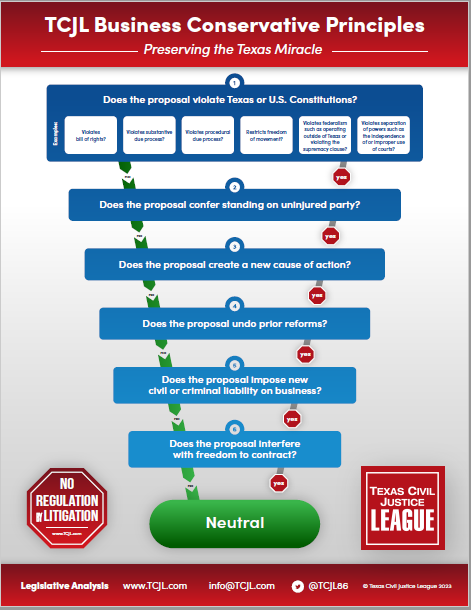
This bill is troubling because it creates a new cause of action, a potential new class action, and new and potentially expansive civil penalty liability on top of those. It is also troubling that the bill imposes a quasi-strict liability standard with mandatory one-way attorney’s fees that incentivize litigation against manufacturers. There is no requirement, for example, that either the attorney general or plaintiffs in a lawsuit show any actual, concrete injury to the minor or the parents. In our view, moreover, it is unlikely that manufacturers will take much comfort in the good faith defense since the essential elements of the cause of action simply ask whether the manufacturer made the device, whether the device automatically enabled the filter, or whether a minor accessed explicit material on the device. In truth, the latter two elements collapse into one: if the minor accessed the material, the device obviously did not enable the filter (or someone wired around it, but that’s not a defense to manufacturer liability). The question then becomes whether the manufacturer made a good faith effort to make the filter work, but we have no doubt that the plaintiff’s response to that will focus on whether the manufacturer should have designed the filter differently but did not choose to do so. And since the bill allows a mass aggregation of individual suits into one or more class actions, we can expect exactly that to happen. We are also concerned that the same rationale supporting this legislation could be used to expand its coverage to include network providers, web browsers, and other intermediaries between the production of the proscribed material and the end user.
HB 1936/SB 417 runs afoul of business conservative principles in another way because it delegates the regulation of a manufactured product to the courts rather than to an administrative agency with specific expertise in the design and manufacturing of that product. This deprives a product manufacturer of an important protection from liability if it fully complies with governmental safety standards. There is no question that the bill involves making electronic devices “safe” for use by minors. But the bill does not give anybody, other than litigants and judges, the authority to create the safe harbor from liability that compliance with government standards is designed to do. Because this bill as filed creates significant new potential liability for businesses, a no-injury cause of action with statutory damages, a substantial new civil penalty, and, in our view, improperly delegates the regulation of a lawful product to the courts, TCJL will urge the Legislature to take a close look at whether the problem it seeks to remedy can be done in another way.