Excerpt from the TCJL Journal Summer 2026, by George Christian (Full PDF here) –
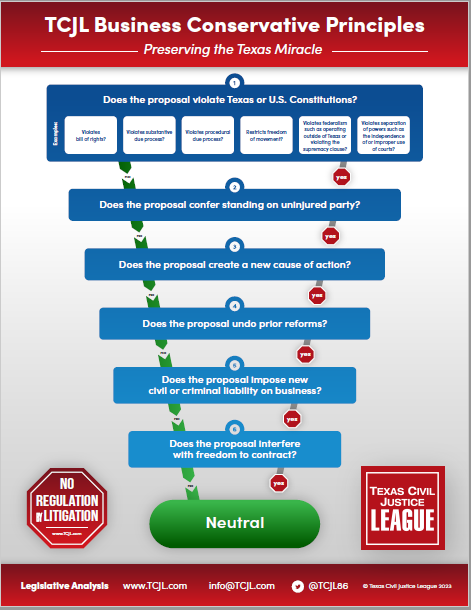
The enactment of SB 8 in 2023 and subsequent legislation allowing members of the public to enforce state policy by way of private litigation has put Texas courts in a difficult, if not untenable, position. Under ordinary circumstances, parties to private litigation must have a “justiciable” interest in a controversy to confer jurisdiction on a court to resolve the dispute. Jurisdictional issues arise in several ways, but the recent legislative trend has introduced a new element to courts’ consideration of their own jurisdiction: the no-injury lawsuit (or “private right of action”) for which the Legislature by statute dictates the court’s jurisdiction in advance.
As we have seen in the SB 8 litigation, parties whom the statute has adversely affected have raised the question of whether courts have jurisdiction to hear SB 8 claims, despite the Legislature’s clear intention to compel them to do so. (Ironically, some parties who defend SB 8 in some of these lawsuits have likewise argued that the courts have no jurisdiction to hear challenges to SB 8.) These suits have thus put the so-called “standing doctrine” at the center of public policy debates over contentious issues. “Standing” merely means “the capacity of a party to bring a lawsuit in court,” or conversely, the power of a court to hear and determine a particular dispute.[1] The question of standing goes to the subject matter jurisdiction of the court. If a party doesn’t have it, the court must dismiss the case. Moreover, standing cannot be waived and can be raised by any party at any time at both the trial and appellate levels. Judges can also raise the issue sua sponte. There is no getting around it.
Federal Standing Doctrine
Both federal and state courts apply the “standing doctrine,” though often in different ways. In federal courts, the doctrine is derived from Article III, §§ 1 and 2 of the U.S. Constitution. Section 1 vests judicial power in federal courts. Section 2 empowers those courts to decide specific “cases” and “controversies.” For example, federal courts have jurisdiction over cases involving federal laws, officials, admiralty and maritime law, controversies between states, or controversies between citizens of different states. The “case or controversy” requirement is referred to as “justiciability,” and the standing doctrine guides courts in determining whether a particular dispute is “justiciable.” The doctrine protects separation of powers because it “ensure[s] that federal courts do not exceed their authority as it has been traditionally understood.” Spokeo, Inc. v. Robins, 136 S. Ct. 1540, 1547 (2016). Additionally, it “prevent[s] the judicial process from being used to usurp the powers of political branches.” Clapper v. Amnesty Int’l USA, 568 U.S. 398, 408 (2013). In other words, federal courts cannot answer abstract questions or give advisory opinions.
So what are the elements of the standing doctrine? Federal courts ask three questions:
- Has the plaintiff suffered an “injury in fact”?
- Is the plaintiff’s injury “fairly traceable to the challenged action of the defendant”?
- Is it “‘likely’ … that the injury will be ‘redressed by a favorable decision’”?
Lujan v. Defs. of Wildlife, 504 U.S. 555, 560-61 (1992). That sounds all well and good, but what exactly does it mean? The most important element is “injury in fact.” SCOTUS has construed that phrase to mean that the injury must be “concrete,” “particularized,” and “actual or imminent.” TransUnion LLC v. Ramirez, 141 S. Ct. 2190, 2203 (2021). We can break these terms down more specifically, but you get the idea. The “traceability” standard is murkier, but courts generally require either “proximate causation” or “but-for” causation. See Lexmark Int’l, Inc. v. Static Control Components, Inc., 572 U.W. 118, 134 n.6 (2014) (“Proximate causation is not a requirement for Article III standing, which requires only that the plaintiff’s injury be fairly traceable to the defendant’s conduct.”); Duke Power Co. v. Carolina Env’t Study Grp., 438 U.S. 59, 74-78) (traceability prong met because there was “but-for cause”). Similarly murky is the redressability standard, which generally requires the court’s judgment to actually remedy the plaintiff’s harm, such as “enjoining the action or awarding damages for the action ….” FDA v. All. For Hippocratic Med., 144 S. Ct. 1540, 1555 (2024).
Federal courts have also discussed a variant of the standing doctrine known as “prudential standing.” This term refers to a case in which a plaintiff meets the requirements for Article III standing, but the court decides not to hear it for other reasons. SCOTUS has not ruled out prudential standing altogether, so the concept continues to linger on.
It is important to point out that SCOTUS has drawn a fairly bright line between its constitutional jurisdiction and Congress’s power to expand that jurisdiction by statute. In other words, Congress cannot merely decree that an injury is “concrete” in order to force the federal courts to hear no-injury cases or controversies. As SCOTUS has held, “an injury in law is not an injury in fact.” TransUnion, 141 S. Ct. at 2205. It should be noted, however, that three of the current SCOTUS justices have taken the position that violations of “private rights” are concrete enough to confer standing. TransUnion, 141 S. Ct. 2215-25. At least for now, however, SCOTUS appears very reluctant to open the floodgates to any private right of action Congress, in its infinite wisdom, decides to send its way.
Texas Standing Doctrine
All state courts subscribe to the standing doctrine in one way or another. In general, state constitutions don’t precisely track the Article III “case” or “controversy” language. The Texas Constitution is one of those. Article II, § 1, specifically separates the legislative, executive, and judicial branches into three departments, each of which “shall [not] exercise any power properly attached to either of the others, except in the instances herein expressly permitted.” Additionally, our constitution includes an open courts provision providing that “[a]ll courts shall be open, and every person for an injury done to him, in his lands, goods, person or reputation, shall have remedy by due course of law.” Art. I, § 13.
The Texas Supreme Court has interpreted these provisions in terms of federal standing doctrine for the most part. The Court has held that in general standing requires “a real controversy between the parties, which … will actually be determined by the judicial declaration sought.” Tex. Ass’n of Bus. V. Tex. Air Control Bd., 852 S.W.2d 440, 446 (Tex. 1993). Like the federal courts, Texas standing doctrine consists of the three elements of “injury in fact,” traceability, and redressability. “Injury in fact” must “concrete or particularized, actual or imminent.” Heckman v. Williamson County, 369 S.W.2d 137, 155 (Tex. 2012). “Traceability” means that the injury may not “result[] from the independent action of some third party not before the court.” Meyers v. JDC/Firethorne, Ltd., 548 S.W.3d 477, 485 (Tex. 2018). And “redressability” requires a finding that there is a “substantial likelihood” that the requested relief will remedy the plaintiff’s injury along the lines of federal law. Id. The Court has recognized a “taxpayer standing” exception that follows federal municipal taxpayer standing rules. Under this exception a taxpayer (of property taxes, not sales taxes) may challenge a “significant” illegal expenditure of public funds. See generally Williams v. Lara, 52 S.W.3d 171 (Tex. 2001).
Federal and Texas standing doctrine do not seamlessly coincide, however, on what constitutes a “concrete injury.” The question arises when a plaintiff alleges a “legal injury” alone, that is, a statutory or constitutional violation. There is also uncertainty as to whether the Legislature can confer standing by statute, as it has attempted to do in SB 8. SCOTX has, for exmple, held that constitutional harms are “sufficient” injuries to confer standing. Heckman, 369 S.W.3d at 155. It has also stated that “[g]enerally, unless standing is conferred by statute, ‘a plaintiff must demonstrate … an interest in a conflict distinct from that of the general public, such that the defendant’s actions have caused the plaintiff some particular injury.” Sneed v. Webre, 465 S.W.3d 169, 180 (Tex. 2015); see also Scott v. Bd. of Adjustment, 405 S.W.2d. 55, 56, holding that “[w]ithin constitutional bounds, the Legislature may grant a right to a citizen or to a taxpayer to bring an action against a public body or a right of review on behalf of the public without proof of particular or pecuniary damage peculiar to the person bringing the suit”).
These statements would seem to suggest that the Legislature by statute may authorize a private right of action for a purely legal injury. If the Scott case has any precedential value, it still speaks only to taxpayer standing, challenges to actions of a “public body,” or a “right of review,” which does not sound like an action for damages for a purely legal injury, as SB 8 authorizes. The interlineation in Sneed, “unless standing is conferred by statute,” does not directly address standing for a legal injury, either. Perhaps the SB 8 standing controversy will provide SCOTX with the right case to decide this question.
It should be noted that two SCOTX justices have recently raised this issue in another context. In re Novartis Corporation (No. 24-0239; October 24, 2025) arose from a qui tam action brought by a private party, Health Selection Group, LLC (HSG), against Novartis under the Texas Medicaid Fraud Prevention Act (§§ 36.001-.132, Human Resources Code) alleging that Novartis defrauded the Medicaid program of millions of dollars through fraudulent marketing schemes. The state declined to take over the action from the qui tam relator, so Novartis moved to dismiss on the basis that the relator lacked standing. The state opposed the motion. The Harrison County district judge denied it, and the Texarkana Court of Appeals followed suit. Novartis sought mandamus relief from SCOTX.
The Court likewise denied Novartis’s petition. In a concurring opinion, Justices Young and Sullivan acknowledged that since the 15th Court of Appeals will have jurisdiction over the appeal, the Court acted properly in deferring until it had the benefit of that court’s ruling. As to Novartis’s standing argument, the concurring justices observed that any analysis of standing should begin with Justice Scalia’s opinion in Vermont Agency of Natural Resources v. United States ex rel. Stevens, 529 U.S. 765 (2000), which upheld the Article III standing of a qui tam relator under the federal False Claims Act. There the high court held that an assignee of the government’s damages claim can have standing “to assert the injury in fact suffered by the assignor.” But, as the justices pointed out, the Texas statute “‘employs a penalty scheme and is not an action for the recovery of damages,’ with money being ‘exacted as punishment for either a wrong to the state or a civil wrong (as distinguished from compensation for an injured party’s loss.” Consequently, the justices queried “[h]ow can it be said, given these statutory differences, that the State has some injury in fact (as opposed to an injury in law) that it could assign to a qui tam relator like HSG?”
Novartis also raised a constitutional question of whether private relators may represent the government in litigation to begin with. In several cases SCOTUS Justices Thomas, Kavanaugh, and Barrett have expressed doubts that qui tam provisions comport with Article II separation of powers. Pointing to the Texas Constitution, art. V, § 21, which assigns the authority to represent the state in court to the attorney general and county and district attorneys, Justices Young and Sullivan opined that “[i]f Texas’s qui tam statute suffers from either of the constitutional flaws Novartis purports to identify, our legislature needs to know it soon and to hear it from a statewide court.”
Under no uncertain terms, federal standing doctrine has rejected the authority of Congress to confer standing by statute. TransUnion, 141 S. Ct. at 2205. This is another way of saying that SCOTUS does not recognize a legal injury as an injury in fact. SCOTX, however, has not yet spoken on whether and under what circumstances it might permit an “injury in law” to be sufficient to confer standing on a party with no concrete injury at all. It has also not yet spoken decisively on whether it would adopt some version of prudential standing, although it has indicated that refusing taxpayer standing to sales tax payers (as opposed to property tax payers) was based on “prudential” considerations. Williams, 52 S.W.3d at 180.
There is more that could be said at this juncture, but much of it would be necessarily speculative. But given the Legislature’s new predilection for creating private rights of action for legal injuries alone may mean that we get some answers sooner rather than later.
For a thorough discussion and exhaustive case review of the Texas standing doctrine, see David Hutchison, “Standing in Texas: Exploring Standing Under the Original Meaning of the Texas Constitution,” Texas Law Review, Vol. 103: 227-267 (2024); https://texaslawreview.org/wp-content/uploads/2024/11/Hutchison.Printer-.pdf (accessed March 19, 2026).
[1] https://www.law.cornell.edu/wex/standing (accessed March 12, 2026).