 A unanimous vote of the House Delivery of Government Efficiency Committee has sent much-discussed artificial intelligence regulatory legislation to the Calendars Committee. CSHB 149 makes reorganizes and makes significant changes from the filed version. Those changes are reflected in the following summary in bold.
CSHB 149 by Capriglione (R-Southlake): Regulates the development and use of AI, as follows:
- Amends § 503.001, Business & Commerce Code (Capture of Biometric Identifiers) to add a definition of “artificial intelligence.”
- Adds § 503.001(b-1) to provide that an individual has not been informed or provided consent for the capture or storage of a biometric identifier for a commercial purpose based solely on the existence of an image or other media on the internet or other publicly available source.
- Amends § 503.001(e) to exempt the training, processing, or storage of biometric identifiers involved in AI systems, unless any of the above is performed for the purpose of uniquely identifying an individual.
- Adds § 503.301(f) to provide that if a biometric identifier used to train an AI system is subsequently used for a commercial purpose, the possessor is subject to regulation and penalties under Chapter 503.
- Amends § 541.104(a)(2), Business & Commerce Code (consumer data protection), to require a possessor of a biometric identifier to assist the controller in complying with security requirements for data collected,stored, and processed by an AI system.
- Adds Subtitle D, Title 11, Business & Commerce Code.
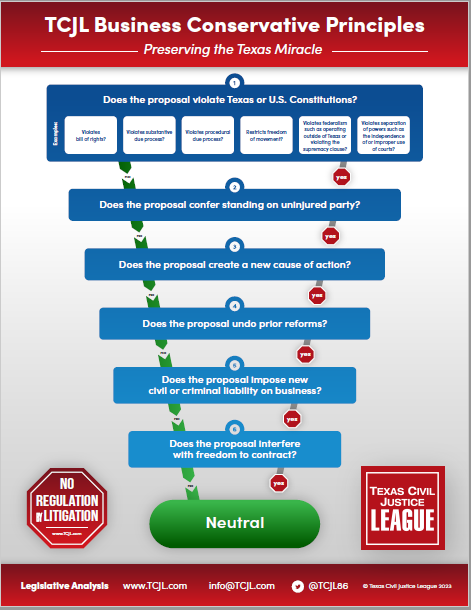
- Adds Chapter 551 and applies it to a person who: (1) promotes, advertises, or conducts business in Texas; (2) produces a product or service used by Texas residents; or (3) develops or deploys an AI system in Texas. (Texas courts may not have subject matter jurisdiction over out-of-state individuals or entities with insufficient contacts with the state. This could render the bill largely unenforceable.)
- Adds § 551.001 to define “artificial intelligence system,” “consumer,” and “Council” (the Texas Artificial Intelligence Council established by Chapter 554).
- Adds Chapter 552 to regulate AI developers and deployers.
- Adds § 552.001 to define “developer” and “deployer.”
- Adds § 552.002 to provide that the statute may not be construed to impose a requirement that adversely affects a person’s rights or freedoms or to authorize any department or agency other than TDI to regulate the business of insurance. (This provision may violate constitutional separation of powers.)
- Adds § 552.003 to preempt local regulation.
- Adds § § 552.051 to require a governmental agency that makes available an AI system intended to interact with the public to disclose that to a consumer and prescribes requirements for the disclosure.
- Adds § 552.052 to Prohibit development or deployment of an AI system to incite a person to commit self-harm, harm another, or engage in criminal activity
- Prohibits an AI system to intentionally use deceptive practices under the DTPA;
- Adds § 552.053 to prohibit a government entity from using AI system to assign social scores.
- Adds § 552.054 to prohibit a government entity from developing or deploying AI systems with biometric identifiers and targeted or untargeted gathering o images or media for the purpose of uniquely identifying a specific individual.
- Adds § 552.055 to prohibit an AI system from being deployed or developed (by any person) that intentionally limits political viewpoint expression. Prohibits an interactive computer service from using an AI system to discriminate a user based on political speech (except for illegal hate speech, obscenity, unlawful deep fake images, or in violation of intellectual property rights).
- Adds § 552.006 to prohibit development or deployment of an AI system that unlawfully discriminates against a protected class.
- Adds § 552.057 to prohibit development or deployment of an AI system with the sole intent of producing or distributing unlawful visual material.
- Adds § 552.101 to give the attorney general exclusive enforcement authority and to bar a private right of action.
- Adds § 552.102 to require the OAG to create and maintain an online mechanism to receive consumer complaints.
- Adds § 552.103 to give the attorney general civil investigative authority.
- Adds § 552.104 to provide for notice of violation and opportunity to cure.
- Adds § 552.105 to authorizes a civil penalty of not less than $10-12,000 for a curable violation;
- Authorizes a civil penalty of $80-200,000 for an uncurable violation;
- Authorizes a civil penalty of $2-40,000 per day for a continuing violation
- Authorizes the OAG to recover attorney’s fees and costs.
- Creates a rebuttable presumption tht a person used reasonable care as required under the statute.
- Allows a defendant to seek an expedited hearing, including a request for a declaratory judgmnet, on good faith belief that no violation has occurred.
- Shields a defendant from liability if: (1) another person uses the AI system for a prohibited purpose; or (2) the defendant discovers a violation through feedback from a third-party, testing (including adversarial testing or red-team testing), following state agency guidelines, or substantial compliance with the most recent version of the “AI Risk Management Framework: Generative Institute of Standards and Technology” or another nationally or internationally recognized risk management framework.
- Bars the OAG from bringing an action against a person for an AI system that has not been deployed.
- Authorizes state agencies to sanction regulated persons and assess penalties of up to $100,000 or to suspend or revoke a license or other certification under certain circumstances.
- Adds Chapter 553 to establish a Sandbox Program under the auspices of DIR.
- Adds Chapter 554 to establish the Texas Artificial Intelligence Council.
There is no question that the committee substitute improves the enforcement sections of the bill by explicitly prohibiting a private right of action and building in additional protections for defendants operating in good faith. As noted above, the bill may still raise constitutional questions pertaining to jurisdiction and separation of powers.