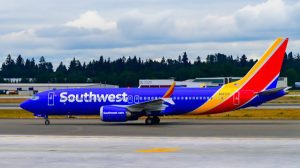
 The Business Court has denied Boeing’s motion for summary judgment in its dispute with the Southwest Airlines Pilots Association over whether Boeing’s misrepresentations about the safety of the 737MAX induced the pilots to enter into a collective bargaining agreement with the airline.
Southwest Airlines Pilots Association (SWAPA) v. The Boeing Company (2026 Tex. Bus. 37; June 9, 2026) is one of a number of lawsuits brought by airline pilots against Boeing for design flaws in the 737 MAX. The pilots allege that they suffered various types of damages caused by grounding the MAX fleet to address the design defects. Boeing moved for summary judgment on grounds that Plaintiff cannot establish proximate causation as a matter of law.
In an opinon by Judge Bouressa, the court denied the motion. Boeing pointed to two federal court decisions from Illinois. The first was brought by Southwest Airlines flight attendants alleging fraud, negligence, and fraudulent and negligent misrepresentations. They pleaded that Boeing’s conduct resulted in lost wages and other damages. Boeing moved to dismiss for failure to state a claim, which the court granted on the basis that Plaintiffs failed to plead facts that, taken as true, would establish “cause-in-fact” and “legal cause” elements of proximate causation. The second case was brought by airline pilots alleging strict liability, negligence, fraudulent concealment, and fraudulent misrepresentation. Again, the district court determined that the pilots failed to plead the elements of proximate causation and that their claim for lost earnings “were too attenuated to be proximately caused by an alleged design defect.”
The court distinguished these cases from the present one based partly on differential pleading standards between Texas and federal courts. The federal rules (FRCP 8, 9(b)) require plaintiffs to plead with “greater specificity,” so federal courts “may assume that the absence of certain facts in a complaint indicates that such facts either do not exist or are not relief upon by the plaintiff.” Texas courts, on the other hand “cannot make such presumptions because plaintiffs need only give fair notice of their claims.” Consequently, Texas litigants “must generally be allowed to replead a deficient claim before suffering an adverse judgment.” In the first case, the federal court didn’t have to allow the flight attendants to replead their claims. Additionally, that case “also involved allegations concerning the flight attendants’ collective bargaining agreement with the airline,” but “the alleged misrepresentations came after the collective bargaining agreement was executied—a fact that differs from the pleadings before this court.” In the second case, the pilots based their claims on “alleged design defects and misrepresentations and omissions to the public in general, which led to the grounding of the fleet and alleged lost income to flight crew.” That isn’t the situation here, either.
Here SWAPA (the assignee of the pilots’ claim) alleged that “the pilots were induced by Boeing’s misrepresentations to SWAPA and its Members to enter into a disadvantageous collective bargaining agreement with Southwest Airlines. The pilots here do not simply ‘seek to recover damages based on plane crashes experienced by other people.’” As SCOTX has stated, the pilots complain “that Boeing made misrepresentations about the MAX with the intent to induce SWAPA and the pilots to agree in the 2016 CBA to fly the MAX.” Boeing Co. v. Sw. Airlines Pilots Ass’n, 716 S.W.3d 140, 150-51 (Tex. 2025). If that is indeed the “core” of SWAPA’s complaint, its pleadings give fair notice.
Still, as Boeing argued, SWAPA’s live pleadings “do include isolated allegations for which, to the extent they form the basis of SWAPA’s suit, proximate causation could be legally foreclosed for the same reasons articulated in the Illinois opinions.” The court responded that “under Texas’ fair notice pleading standard, the Court cannot presume that SWAPA is unable to articulate recoverable damages attributable to that theory simply because its pleadings contain other damage allegations.” And before granting summary judgment against SWAPA, SWAPA must have the opportunity to amend its pleadings to address deficiencies in the causation element. The court can’t just assume that those facts don’t exist. The court thus denied Boeing’s MSJ for now.