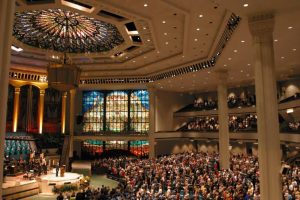
 The Business Court has granted summary judgment to the Second Baptist Church on most claims brought by an association of church members that contested a change in church bylaws regarding the appointment of a new pastor and management of church assets.
Jeremiah Counsel Corporation v. Ben Young, et al. (2026 Tex. Bus. 46; July 15, 2026) arose from a dispute over the governance and governing documents of the Second Baptist Church of Houston. For most of its history since its founding in 1928, the church “operated with a representative governance structure that vested significant voting rights in the individual church members, including the right to approve or reject material changes to the corporate by laws. Defendant Young served as the church’s senior pastor from 1978 until 2024, and in 2023, along with other church members, initiated an effort to amend the church’s governing documents. This effort resulted in May 2023, when the church board of trustees voted unanimously to amend the articles of incorporation and bylaws to abolish all member voting rights, remove board of trustee oversight for the selection of a senior pastor and transferring the sole right to selected the pastor to the serving senior pastor, and giving broad discretion over church assets to a “ministry leadership team” (MLT). A large majority of those present at a church business meeting voted to approve the changes.
In April 2025, Plaintiff, a non-profit corporation formed by long-standing current or former church members, filed suit challenging the vote, as well as subsequent actions by the MLT, asserting association standing and derivative standing on behalf of the church. Plaintiff asserted that Defendants, at the instigation of Pastor Young, engineered the amendments to the governing documents to get his son into the job. They pleaded fraud, breach of fiduciary duty, and statutory violations and sought to void both the amendments and the subsequent appointment of Pastor Young’s son (who dismissed his father from the church and nominated his own friends and family members to the MLT). Plaintiff additionally challenged the transfer of churh assets, including a multi-media platform called “The Winning Walk,” to the control of the MLT. Defendants moved for summary judgment on the basis, among other things, of the church autonomy doctrine.
In an opinion by Justice Dorfman, the court granted summary judgment on some claims and denied it on others. As a threshold issue, however, the court had to grapple with the church autonomy, or ecclesiastical abstention, doctrine. Texas has adopted the “neutral principles of law” approach to the question “ensuring that religious organizations are afforded the same legal regularity as secular entities when they choose to utilize state-sanctioned corporate forms.” In this situation, the church opted to create a nonprofit corporation subject to Texas corporations law, so Plaintiff’s claim that the vote to amend the governing documents failed to comply with the TBOC “may be resolved by the application of neutral principles of law.” The court then conducted a claim-by-claim analysis to determine its jurisdiction, grouping Plaintiff’s claims into four categories: declaratory relief as to the 2023 amendments; derivative claims; claims for an accounting, and injunctive relief.
First, the court determined (and Defendants conceded) that it had jurisdiction over the validity of the amendments to the church’s articles of incorporation and bylaws. Second, the court found that it didn’t have jurisdiction over the derivative claims “that relate to core Church governance decisions.” Similarly, Plaintiff’s conversion cause of action for the decision to transfer church property also ran afoul of the church autonomy doctrine. Third, Plaintiff’s claims for an accounting, however, were permissible because they are governed by the TBOC. But did Plaintiff have standing to pursue the claims in the first place? The court concluded that Plaintiff had associational standing for its declaratory and injunctive causes of action because “(a) its members would otherwise have standing to sue in their own right; (b) the interests it seeks to protect are germane to the organization’s purpose; and (c) neither the claim asserted nor the relief requested requires the participation of individual members in the lawsuit” (citations omitted).
But it didn’t have standing for its derivative claims because they don’t allege ultra vires acts that: (1) go “beyond the scope of the purpose or purposes of the corporation as expressed in the corporation’s certificate of formation,” or (2) are “inconsistent with a limitation on the authority of an officer or director … as that limitation is expressed in the corporation’s certificate of formation.” § 20.002(c), TBOC. Since the stated purpose of the corporation is to operate as a church, a vote to amend the governing documents and change internal administrative operations did not contradict it. Plaintiff also couldn’t point to any violation of an expressed limitation on officer authority in the certificate of formation. And even if Plaintiff could show ultra vires acts, its claims still relate to core governance decisions of the church, running afoul of the church autonomy doctrine.
So did the church validly adopt amendments to its governing documents? The TBOC, § 22.105(b), “requires a nonprofit corporation to give its voting members written notice containing the proposed amendment or a summary of the changes.” The church didn’t do that, so the amendment to the 1928 articles was invalid. It granted Plaintiff’s motion for partial summary judgment on that issue. But as to the bylaws amendments, the church was within its rights to make an oral announcement at a regularly scheduled worship service before the meeting. It did that, and it also made written announcements in two weekly newsletters. The vote on the bylaws thus complied with the TBOC.
Moving to the fraud claim, the court found that it couldn’t adjudicate it because the claim rested on Plaintiff’s interpretation of the church’s operation as a “biblical” institution. Whatever that may be, the court demurred on getting into it or asking a jury to determine the meaning of “biblical church.” Additionally, since officers and directors of a nonprofit corporation do not owe fiduciary duties to individual shareholders (only to the corporation), Plaintiff’s nondisclosure claims would still be impermissible. And, as the court further found, the articles of incorporation, even as invalidly amended, did not conflict with the bylaws with respect to the election of the trustees. The articles don’t specify who elects the trustees, but the bylaws do. So the question of the church members’ “historic voting rights” wasn’t based on the language of the articles or the bylaws, which, as validly amended in 2023, allows members to vote at church business conferences (which they did in this case). The court granted summary judgment to Defendants on those claims as well.
Defendants also sued the church’s legal counsel for his actions prior to the vote and after the vote as a member of the MLT. The court threw these claims out on the same basis as the others, the church autonomy doctrine and Plaintiff’s lack of derivative standing. Even if Plaintiff’s malpractice claims against the lawyer could withstand the threshold questions, the court still couldn’t entertain them because the Business Court has no jurisdiction over legal malpractice actions. The court dismissed the lawyer from the case.