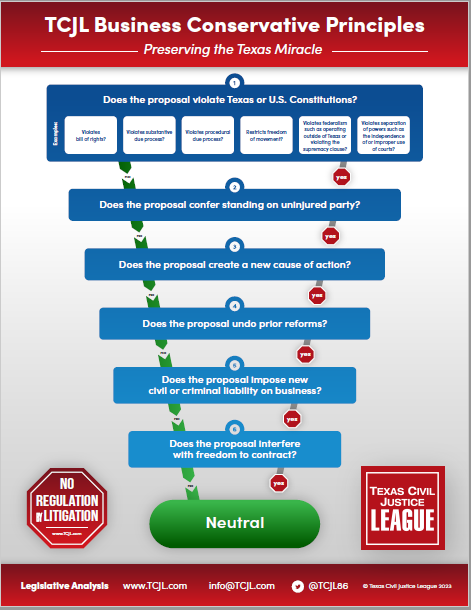
Among the many bills filed to, in one way or another, punish or constrain businesses from referring to so-called “ESG” factors in operating their businesses as they see fit, HB 1239 is on the move. But the form in which the bill emerged from committee last week confirms just how difficult it is to legislate on such a vague and indeterminate concept and brings into question the nature of the whole enterprise.
As originally filed, HB 1239 (and its Senate companion SB 833) simply prohibited an insurer from considering a customer’s “ESG score” or so-called “diversity, equity, and inclusion” factors in rating. Simple enough, right? Just don’t do it. The problem, however, is what is “it”? The filed version of the bill had no definition of “ESG,” which, as we understand it, refers to “environmental, social, governance” or “diversity, equity, and inclusion” (DEI for short) factors. It is not our purpose here to offer definitions, first because they don’t exist in any form recognizable as a legal standard, and second because those concepts are so entirely subjective that any attempt to define them would have all the solidity of thin air. As far as we can tell, those terms refer to aspirations and goals currently operative within the free market system rather than a set of hard and fast policies, mandates, requirements, or the like. But whatever they do or do not mean, it is at best puzzling how one can write a statute sufficiently specific to hold an entity liable for doing or not doing it.
From the appearance of the committee substitute, it appears that HB 1239 recognizes this difficulty. CSHB 1239 still has no definition of ESG and gets rid of DEI altogether. What it does have, however, are several qualifications and exceptions that purport to tell us what ESG and DEI are not. As such, they offer a definition by exclusion rather than a specific standard of conduct upon which one can hang a legal duty and liability. While the substitute still prohibits an insurer from considering ESG factors, it now:
- Does not prohibit an insurer from taking actions based on “an ordinary insurance purpose,” such as “the use of sound actuarial underwriting principles or financial solvency considerations.”
- Does not require an insurer to file rates for any line, type of insurer, or type of insurance that is not specifically required by statute.
- Does not require an insurer to write any line or type of business the insurer does not write already or to make a material change in the insurer’s current business plans.
- Does not create a private cause of action or an independent basis for a civil or criminal proceeding, including a cause of action based on disparate impact in the field of insurance.
- Does not prevent an insurer from using relevant information related to the risk being insured even if that information is used to develop an ESG score.
- Bars TDI from requiring an insurer to conduct a disparate impact analysis unless specifically required by statute and from adopting a rule requiring an insurer to use ESG factors.
While CSHB 1239 may not wholly satisfy the most enthusiastic proponents of “anti-ESG, anti-DEI” legislation, short of putting the state squarely in the middle of the underwriting business and the economic system that depends on that business, it is hard to see what the bill could do otherwise. As we have learned from more than 35 years of direct experience, insurance markets are extraordinarily sensitive to shifts in the liability climate at the state level. In the heat of a strident ideological debate such as ESG and DEI, it can be easily forgotten that the business of insurance, or any other business for that matter, is not a public utility and can disappear from the scene as quickly as it came. The basis of the free market system, which most Texans hold very dearly, is government non-interference in a business’s ability to make and provide lawful goods and services, to invest its assets for what it considers the best interests of its owners, employees, and customers, and to increase its sphere of economic activity. This is what Adam Smith referred to as the “invisible hand” of enlightened self-interest. Once the heavy hand of government becomes too visible, however, the whole basis of the system shifts to something else.
What is true of the insurance business is equally true of all businesses targeted by ESG legislation introduced this session, though insurance carriers, financial institutions, and public and private investment funds, seem to have drawn particular ire. These bills include SB 1060, SB 1446, SB 1683, HB 709, HB 2752, HB 3339, HB 3661, HB 4794, HB 4802, and HB 5048. Some of these bills attack business and investment decisions, while others target “political” shareholder proposals or impose liability on corporate directors. Some of these bills are framed in terms of punishing “boycotts” of certain businesses, such as fossil fuel producers or firearms and ammunition manufacturers. This is somewhat ironic, since major oil companies such as Shell, Total, Exxon, and BP are among the largest investors in renewable energy in the world and are likely to have pretty good “ESG scores,” whatever those may be. It would be an odd result indeed if the Teacher Retirement System, for example, or a bank or private investment firm could be punished for investing in or loaning money to any of them because the investment or loan might, in some small part, encourage the development of renewable energy.
The frustrating thing about these bills, at least from a business perspective, is that they get in the way of what businesses do best: respond to market participants and market forces, pivot to new and innovative technologies, and diversify and expand the economy. Isn’t that what we all want, regardless of which side of the aisle? And isn’t that exactly what the Texas Miracle has produced in the last 25 years? The Texas economy is a mirror reflection of the world economy by virtue of our size, dynamism, and strong public policy for growth. We’re not sure exactly what the impetus is for altering that approach.
The other troubling thing about these bills is their immense liability implications. The enforcement mechanisms range from private and statutory causes of action and civil and administrative penalties to contract cancellation, blacklisting, and who knows what else. As we have seen in the case of HB 1239, as broadly as they are drafted and as amorphous as the conduct they seek to sanction is, the courts will never hear the end of it. There is not an entity of significant size doing business in this state that could not become mired in endless and destructive litigation over what is a essentially a political question involving the expression of First Amendment speech rights (which businesses share with individuals). Texas businesses are the best judges of what is good for them, their investors, their employees, and their customers when it comes to their operations and future growth. Let them alone, and Texas will continue to flourish. Sue them “into oblivion,” as was recently remarked in a related context, and it won’t.