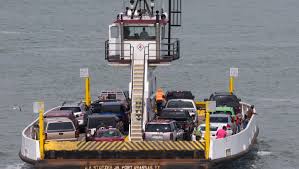
 The Corpus Christi Court of Appeals has affirmed a judgment in favor of a plaintiff claiming injuries caused by a ferry accident. The court, however, reversed an award of pain and suffering damages to the plaintiff’s uninjured children.
Texas Department of Transportation v. Christopher Gover, Individually and as Next Friend of C.G., I.G., S.G., and J.G., Minor Children (No. 13-24-00263-CV; April 30, 2026) arose from an accident in which Plaintiff was injured when one of TxDOT’s Port Aransas-Aransas Pass ferry lost an engine and crashed into the landing ramp. Plaintiff alleged that he suffered soreness and pain in his neck, back, and knees. Plaintiff sued TxDOT for negligence, asserting that government immunity was waived under § 101.021, CPRC. He sought damages for past and future pain and mental anguish, past and future medical expenses, and personal property damage (to his pickup truck) on behalf of himself and his four children. TxDOT asserted immunity from suit and liability. A jury found TxDOT negligent and awarded Plaintiff $1,655,467.54 in damages. Plaintiff moved to enter judgment in the amount of the statutory cap of $250,000 and $5,000 plus pre-judgment interest for each of his four children. TxDOT moved for JNOV. The trial court denied the motion and entered judgment for Plaintiff. TxDOT appealed.
In an opinion by Justice Peña, the court of appeals affirmed in part and reversed in part. TxDOT argued that the “emergency exception” to the TTCA’s waiver of immunity applied. That exception provides that if the claim arises from the action of an employee while reacting to an emergency situation, and the employee’s action complies with the applicable laws and ordinances (or if no law or ordinances, the action is not taken with conscious indifference or reckless disregard for the safety of others), the waiver does not apply. § 101.055(2), CPRC. Here the jury charge included a question asking the jury to determine whether the TxDOT employee was reacting to an emergency situation. TxDOT asserted that the evidence at trial clearly established that the engine failure created an emergency situation. But the jury heard evidence from a TxDOT captain and safety coordinator that he had experienced such engine cut-offs in the past without incident and that ferry captains are trained to deal with it. The court determined that the jury could have “credited and inferred from this testimony that the engine loss on [the date of the accident] was not an ‘unexpected’ situation and therefore did not give rise to an ‘emergency’ as defined in the jury charge.” The jury could also have reasonably concluded that the ferry captain had time for deliberation and, in fact, took several measures to avoid colliding with the landing ramp.
TxDOT argued next that Plaintiff failed to present expert evidence showing that TxDOT breached the duty owed by a reasonably prudent ship captain in responding to an emergency situation. Taking this argument as a challenge to the legal sufficiency of the evidence supporting the breach element of Plaintiff’s claim, the court had to decide whether expert testimony was required on this issue. TxDOT asserted that a ferry boat is “a piece of specialized equipment and operating one involves specialized techniques.” Consequently, expert testimony was required to show a breach of duty. But as the court pointed out, Plaintiff alleged that the captain failed to blow the horn warning of imminent danger to give passengers time to protect themselves. This allegation did “not fall beyond a lay person’s common understanding,” so no expert testimony was needed. But even if it was, the court went on, Plaintiff presented probative expert testimony on the standard of care and breach through Plaintiff’s TxDOT witnesses, to which TxDOT did not object. (Each of them indicated that they would have blown the horn in an emergency situation.)
Finally, TxDOT challenged the award of past physical pain and mental anguish damages to Plaintiff’s children. The court found that Plaintiff produced no evidence supporting the award. Plaintiff held one of his children during the incident, while the other three were sitting in the truck. None of them sought or required medical treatment, and none testified. There was thus no basis for the award of past physical pain. As to the award of mental anguish damages, Plaintiff again presented no evidence that mental anguish “had any detrimental effect to the children’s physical health” or that any of the children sought treatment or medication to cope with it. At most, “[t]he evidence presented to the jury regarding the minor children’s mental anguish was nothing ‘more than mere worry, anxiety, vexation, embarrassment, or anger to support any award of damages” (citations omitted). Additionally, Plaintiff didn’t prove by direct evidence “the nature, duration, and severity of [his children’s] mental anguish, thus establishing a substantial disruption in their daily routine” (citation omitted). The court thus reversed that part of the judgment, but otherwise affirmed.