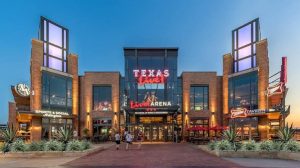
 The Fort Worth Court of Appeals has reversed a $60.5 million judgment, $50 million of which were for punitive damages, against numerous entities associated with an Arlington entertainment complex.
Arlington Pavilion, LLC d/b/a Texas Live!; TXL Western Saloon, LLC; PBR Cowboy Bar – TX Live; Arlington Live, LLC; Arlington Ballpark District Entertainment Block, LLC; Inner-Parish Security Corp.; Hasan Perryman; Steed Dunnill Reynolds Bailey Stephenson LLP; and C. Tim Reynolds v. Abel Rodriguez and Cynthia Rodriguez (No. 02-25-00287-CV; October 15, 2026) arose from an incident between a security guard and a patron of PBR Cowboy Bar. When leaving the bar, one of the Plaintiffs asked the security guard “about the fate of abandoned souvenir glasses.” After a brief conversation, Plaintiff took a glass and walked away to a nearby pizza counter. The guard followed them to retrieve the glass, and the two got into a scuffle, which ended when the guard hit Plaintiff over the head with a glass bottle. Plaintiffs sued the guard, his employer Inner-Guard, and numerous entities connected to the bar, asserting negligence, vicarious liability, negligent hiring, and other causes of action.
After a trial, the jury found Texas Live! and Inner-Parish liable for negligence. It allocated 70% of fault to Texas Live!, 30% to Inner-Parish, and 0% to Plaintiff, and awarded $5 million in compensatory damages. It further found that the guard acted with malice and imposed punitive damages of $50 million against Texas Live!, $5 million against Inner-Parish, and $500,000 against the guard. When the trial court entered judgment, it treated Texas Live! as synonymous with the other entities collectively. That wasn’t all. After it entered judgment, the trial court sanctioned Inner-Parish for failing to disclose that it had a $5 million excess insurance policy. The court ordered it to pay, jointly and severally, the whole $5 million. Defendants appealed.
In an opinion by Chief Justice Sudderth, the court of appeals reversed and remanded. First, the entities argued that there was legally insufficient evidence to support the duty elements of Plaintiffs’ claim. Inner-Parish was an independent contractor hired to provide security for the entertainment complex. Plaintiffs contended that the entities controlled the contractor’s work and thus had a legal duty to Plaintiffs.Plaintiffs argued that the entities’ license to sell alcohol conferred “a nondelegable duty on the permittee to ‘maintain exclusive occupancy and control of the entire licensed premises in every phase of the storage, distribution, possession, … transportation[,] and sale of all alcoholic beverages purchases, stored[,] or sold on the licensed premises.” § 109.53, TABC. But nothing in the statute refers to imposing a “duty to control security-related subcontractors for purposes of a common law negligence claim.” In any event, since Plaintiffs offered no evidence showing which entity or entities actually held the permit, the court didn’t need to reach the statutory control issue.
Plaintiffs then tried to argue control based on the security contract with Inner-Parish. The problem was, none of the entities signed the contract. Indeed, the only signatory, JPG, wasn’t a party to the lawsuit. Plaintiffs attempted to “daisy-chain” JPG’s separate management contract, but to no avail. “Even putting [the question of the validity of the theory] aside, only two of the Entities were signatories to the management contract with JPG, so the daisy-chained-contract theory could not apply to three of the five Entities,” observed the court. “Moreover, even as to the two signatory Entities, [Plaintiffs] do not identify any provision of the management contract that explicitly retains the signatory Entities’ control over JPG’s subcontractor hiring or training of security guards.” No contractual duty here.
Two strikes down, Plaintiffs tried out an actual control theory. But even if someone had actual control of something, Plaintiffs couldn’t show who that person was. Plaintiffs pointed to testimony given by a number of witnesses under the Texas Live! umbrella but tailed to identify for whom they worked. Plaintiffs’ security expert wasn’t any better at that. Consequently, “[b]ecause there was no evidence that one of the five Entities was the actor engaged in the allegedly controlling actions, [Plaintiffs’] actual-control theory fail[ed].” The court reversed the judgment against the entities.
What about Inner-Parish? First, the entities shouldn’t have been included in the jury charge, much less have appeared in the broad form negligence question for allocation of fault. When the jury assessed damages against Texas Live!, the stand-in for the entities collectively, that skewed the allocation between Inner-Parish and Plaintiff. Given this mess, the court sent the case against Inner-Parish back to the trial court for new trial. As to the security guard, Plaintiffs didn’t seek jury findings holding him liable for anything, so the finding of malice and award of punitive damages lacked an underlying liability finding. Observing that Texas had no cause of action for malice, the court held that Plaintiffs, by waiving their negligence claim against the guard, waived any damages they might have recovered from him. The court reversed the judgment against the guard and entered judgment that Plaintiffs take nothing from him.
Now to the sanctions for failing to disclose the excess insurance policy. The trial court found that Inner-Parish had committed an abuse of the discovery process, as prescribed by TRCP 215.3. But the rule “contemplates certain types of sanctions in particular,” which are enumerated in TRCP 215.2(b). Here the trial court imposed a punitive fine in the amount of Inner-Parish’s excess coverage. This penalty isn’t authorized by the rule, so “to the extent the trial court relied on Rule 215.3 for its sanctions order, it abused its discretion by exceeding Rule 215.3’s governing rules and principles.” Plaintiffs argued that the trial court had inherent authority to impose a penalty, but, as the court of appeals pointed out, “the trial court did not make the predicate findings necessary to support an exercise of its inherent sanctioning authority.”
Even if it had, the court went on, the record did not support the predicate findings because there was no evidence of bad faith. “The Inner-Parish employee who handled the company’s discovery testified that she had not realized that the policy needed to be produced in discovery,” the court noted. “There was no evidence that she had discussed the policy with others or intentionally withheld the policy.” Absent contradictory evidence of an improper motive, the court declined to invent it. The trial court’s sanctions order also applied to Inner-Parish’s counsel, but the court found “there was even less evidence that he had acted in bad faith.” In fact, the record showed that he didn’t know anything about it.The trial court abused its discretion by issuing the sanctions order. The court vacated it.