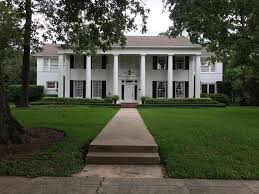
Charles W. Duncan, Sr. House
The Houston [14th] Court of Appeals has affirmed a trial court order granting an appraisal district’s motion for summary judgment in a suit challenging the ARB’s denial of a tax exemption for property owned by a charitable organizations on the basis that the property was primarily used as a private residence.
Duncan House Charitable Corp. v. Harris County Appraisal District (No. 14-24-00682-CV) November 13, 2025) arose from a dispute between the Cantrells, owners and residents of the “Charles W. Duncan Sr. House,” a designated historic landmark by the City of Houston and National Park Service, and the Harris County Appraisal District (HCAD) over the tax exemption status of the historic landmark. The Cantrells filed for a charitable organization property tax exemption in 2017, after founding Duncan House Charitable Corp. with the exclusive objective to preserve the house. The Cantrells also signed an agreement that split the ownership of the property from community ownership into fifty percent separate ownership between Mr. and Mrs. Cantrell. Following this agreement, Mrs. Cantrell deeded her share of the property to Duncan House and filed for a property tax exemption under § 11.18, Tax Code.
The Cantrells had used the property as their primary residence since 1984 and maintained a homestead exemption since 1988. Mr. Cantrell secured an over-65 homestead exemption in 2009, and this exemption was intact when Mrs. Cantrell filed for the charitable exemption under Duncan House’s fifty percent ownership. Mr. Cantrell re-applied for the over-65 homestead exemption for his fifty percent of the property in 2018. HCAD denied Duncan House’s application for a charitable organization tax exemption for 2017. Duncan House filed suit against HCAD after the ARB rejected its protest against HCAD’s denial for an exemption for tax years 2017 and 2018. Duncan House also deeded ownership back to Mrs. Cantrell at the end of 2018.
Both parties filed traditional motions for summary judgement. Duncan House argued the property qualified as a charitable organization due to the small percentage of the total property the Cantrells occupied for their residence. HCAD reponded that the separate ownership agreement and Mr. Cantrell’s continued use of the homestead exemption should disqualify the property from receiving a charitable organization exemption. HCAD argued further that Duncan House did not meet the requirements of § 11.18, which requires the charitable organization to: (1) engage exclusively in the preservation of a historical landmark; and (2) exclusively use the exempt property. The statute also provides that use of the property by persons who are not charitable organizations doesn’t destroy the exemption as long as the use of the exempt property is incidental to use by qualified charitable organizations and limited to activities that benefit the beneficiaries of the charitable organizations that own or use the property. The trial court denied Duncan House’s motion for summary judgement and granted HCAD’s motion without specifying grounds. Duncan House appealed
In an opinion by Justice Bridges, the court of appeals affirmed. Duncan House contended that the property was not required to be used exclusively for charitable use and the the Cantrells’ use of “four percent” of the property as a residence qualified as “incidental” under § 11.18. HCAD argued that the statute required a charitable organization’s property to be owned and used exclusively for charitable purposes, except for “use incidental to the organization’s charitable functions.” Consequently, Mr. Cantrell’s fifty percent ownership of the property as a residential homestead did not qualify as “incidental.” The court looked to Bexar Appraisal District v. Incarnate Word College, 824 S.W.2d 295 (Tex. App.—San Antonio 1992, writ denied), in which the San Antonio Court of Appeals reversed a judgement granting a similar § 11.21 exemption for property used exclusively for educational purposes to a university-owned house used as a private residence by the president of the university. That court held that “because the house was primarily used as a private residence, this use was not an incidental use, and therefore the house was not used exclusively for educational purposes.” The court found that the Cantrells used this property primarily as a residence and that HCAD conclusively disproved an element of Duncan House’s charitable organization exemption claim.
TCJL Intern Haden Knobloch researched and prepared the first draft of this article.