In an important decision arising from the ongoing Winter Storm Uri multidistrict litigation, the Houston [1st] Court of Appeals has reversed the MDL pretrial court’s partial denial of defendant power generators’ Rule 91a motion to dismiss claims brought by hundreds of retail electricity consumers.
The issue before the court of appeals in In re Luminant Generation Company LLC, NRG Texas Power LLC, Calpine Corp., Exgen Handley Power, LLC n/k/a Constellation Handley Power LLC, et al. (No. 01-23-00097-CV and four other bellwether cases; issued December 14, 2023) was whether the MDL pretrial court abused its discretion when it declined to dismiss negligence, negligent undertaking, and nuisance claims against the generators under Rule 91a. Plaintiffs asserted that generators owed them a legal duty to “continuously supply electricity to the power grid, and thus to all retail customers.” They alleged that the generators breached this duty by failing to weatherize andmaintain their facilities and equipment to prevent loss of electrical power, failing to adequately train their employees, failing to provide either electricity or reserve electricity to the grid, and failing to supply sufficient electricity to the grid to ensure reliability. The defendant generators responded that they have no contractual or other special relationship with retail customers that give rise to a legal duty to continuously supply power to the grid.
In an opinion by Chief Justice Adams, the court of appeals agreed with the generators. Having first determined that no special relationship between the parties supports the existence of such a duty, the court determined that, contrary to plaintiffs’ argument, the Legislature did not create a duty when it deregulated the electricity market in 2001. Instead, it specifically excluded wholesale power generators from the definition of “public utility” and confined their role in the market solely to producing power “that is intended to be sold at wholesale” to retail electric providers. Not only did the Legislature decline to recognize a broader duty (which it could have done, either when it deregulated the market or reformed it in 2021 and 2023), however, but no Texas courts have done so.
The question then became whether the court should create a new duty. Walking through the analysis set out in Greater Hous. Transp. Co. v. Phillips, 801 S.W.2d 523 (Tex. 1990), the court wisely concluded that it should leave the issue to the Legislature. We will not go through each of the factors here (we commend the opinion to you for the full analysis), but the gist of the matter is that the court decided that the legislative and regulatory scheme was so complex and comprehensive that the judiciary needed to stay out of it. It also pointed out that making wholesale generators guarantors of a continuous supply of electricity on the grid would make electricity very expensive for consumers and deter the development of new power generation in Texas. The court thus declined to create a new negligence-based duty.
As to plaintiffs’ negligent undertaking claim, the court observed that plaintiffs merely replead their negligence claim under that theory. Pointing out that negligent undertaking requires an actual affirmative “undertaking” and cannot be based on an omission, the court quickly concluded that all of plaintiffs’ claims alleged failures to act. As the court concluded, “the retailers customers have not directed us to any Texas authority, and we are aware of none, that transforms the contractual duties owed by wholesale power generators to the retail electric providers under the current statutory framework into tort duties owed by wholesale power generators to the third-party retail customers.” Finally, the court disposed of the nuisance claims because, as SCOTX has ruled, “nuisance” is not a cause of action by a “type of injury.” Having no other surviving cause of action against the generators, the customers’ assertions of nuisance failed as a matter of law. The court consequently granted mandamus ordering the pretrial court to dismiss the negligence, negligent undertaking, and nuisance claims.
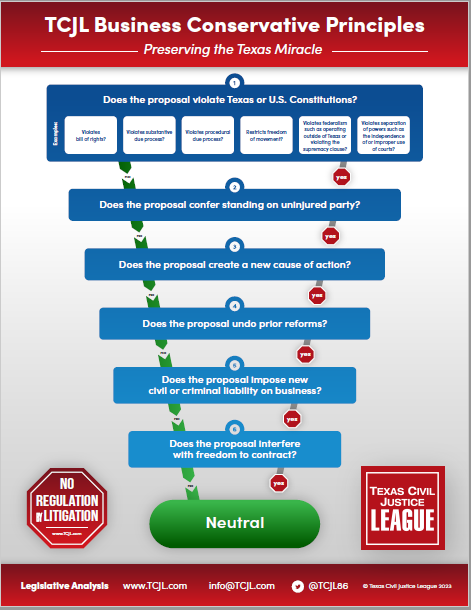
This is a relatively straightforward exercise of restraint and respect for separation of powers. We just wish every branch of government thought as constitutionally as the court of appeals did in this case.