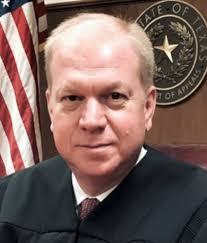
Chief Justice Matt Johnson
The Waco Court of Appeals has affirmed a substantial judgment against an employer and employee driver arising from an accident that left Plaintiffs with serious and permanent injuries.
Roger Landry, Kenneth Porter and Q.A. Services, L.L.C. v. Philip Currie and Charlotte Currie (No. 10-23-00346-CV; January 29, 2026) arose from a 2019 accident between a commercial truck and a passenger vehicle. Landry, an employee of Q.A., was returning from a jobsite in a truck owned by Porter, a co-owner of Q.A. At an intersection in Limestone County, he ran a red light and collided with Plaintiffs’ pickup. After the accident, Landry gave a blood sample that showed a BAC of 0.114 and detected marijuana. Landry was convicted of intoxication assault and sentenced to seven years confinement. Plaintiffs suffered severe injuries in the accident, leaving Charlotte in a medically-induced coma for a month and Philip with traumatic injuries. Both Plaintiffs can no longer care for themselves. Plaintiffs sued Landry for negligence and gross negligence, Porter for negligent entrustment, and Q.A. for respondeat superior and negligent supervision, training, and retention. The jury found that Landry was acting in the course and scope of employment and that Defendants proximately caused the accident. It apportioned responsibility as 30% for Landry, 20% for Porter, and 50% for Q.A. and awarded nearly $35 million in damages to Charlotte, $5.75 million to Philip and $806,400 in punitive damages against Landry. Plaintiffs accepted a remittitur from the trial court, resulting in a total damages award to Plaintiffs of $10,979,382 in noneconomic damages and $3,562,458 in economic damages. The trial court entered judgment on the verdict. Defendants appealed.
In an opinion by Chief Justice Johnson, the court of appeals affirmed the judgment as modified. First, Porter argued that the evidence was legally and factually insufficient to support the jury’s negligent entrustment finding. The evidence indicated that Landry had two recent arrests, one involving public intoxication and the second driving while intoxicated, though in neither case was he on duty or driving a company vehicle. Porter knew about the arrests and instructed Landry not to drink in any of his trucks of take them to the bar (in fact, Porter bailed Landry out of jail following both arrests). There was no evidence that Landry had any prior accidents or infractions while driving Porter’s vehicles, but Porter admitted that at the time he entrusted the vehicle to Landry, he knew Landry was an alcoholic and got drunk at remove jobsites. Based on this record, the court concluded that there was sufficient evidence to support the jury’s finding on two disputed elements of the negligent entrustment theory: that Porter entrusted the vehicle to a reckless driver and that Porter knew or should have known Landry was a reckless driver.
Porter and Q.A. then argued that the trial court’s jury instruction on negligence was improper as to Q.A. because it only included a general negligence theory rather than negligent supervision, training, and retention. The court determined that Plaintiffs’ pleadings alleged claims for negligent hiring, supervision, or retention and submitted evidence at trial pertaining to that claim. But, the court observed, “general negligence and negligent hiring, supervision, or retention are mutually exclusive modes of recovery than that of general negligence with different proof requirements.” Consequently, the trial court erred when it didn’t submit a separate question of employer liability with the additional elements.
Although Plaintiffs’ could not recover on their negligent hiring claim against Q.A., however, they had an independent basis of recovery on their respondeat superior theory. The only question there was whether Landry “was acting in furtherance of Q.A.’s business for the accomplishment of the object for which he was employed.” Porter agreed that once Landry took the truck from the company yard to go a jobsite, that truck was being used for Q.A. business. He also admitted that Q.A. employees expected to be paid for their time driving to the jobsite. At the time of the collision, Landry was returning the truck to the company yard so that it would not be left at the jobsite when he became ill and couldn’t work. One way or another, Landry had to return the truck because he wasn’t authorized to drive it to his residence. Consequently, the “coming and going” rule did not apply. The court concluded that more than a scintilla of evidence supported the jury’s finding that Landry was acting with the course and scope of employment when the accident occurred.
Turning to the damages, Defendants argued that the evidence was legally and factually insufficient to support awards for Plaintiffs’ past and future physical pain and mental anguish, Charlotte’s past and future physical pain and mental anguish, Charlotte’s future physical and mental impairment, and Phillip’s future physical impairment. Landry challenged the jury’s award of noneconomic damages. The court reviewed the evidence and concluded that the jury’s awards were neither manifestly unjust nor unreasonably compensated Plaintiffs for their injuries. Likewise, the court upheld the award of noneconomic damages and punitive damages as within the province of the jury based on the evidence. It did modify the judgment to reduce Q.A.’s proportionate responsibility from 50% to 30% based on its ruling that the evidence didn’t support the jury’s finding of negligent hiring against Q.A. because the proper instruction was not submitted.